AnalysisCost of livingAll levels
Canada cost of living 2026: groceries up 30%, food banks at a record
By VotersDesk · · 7 min read
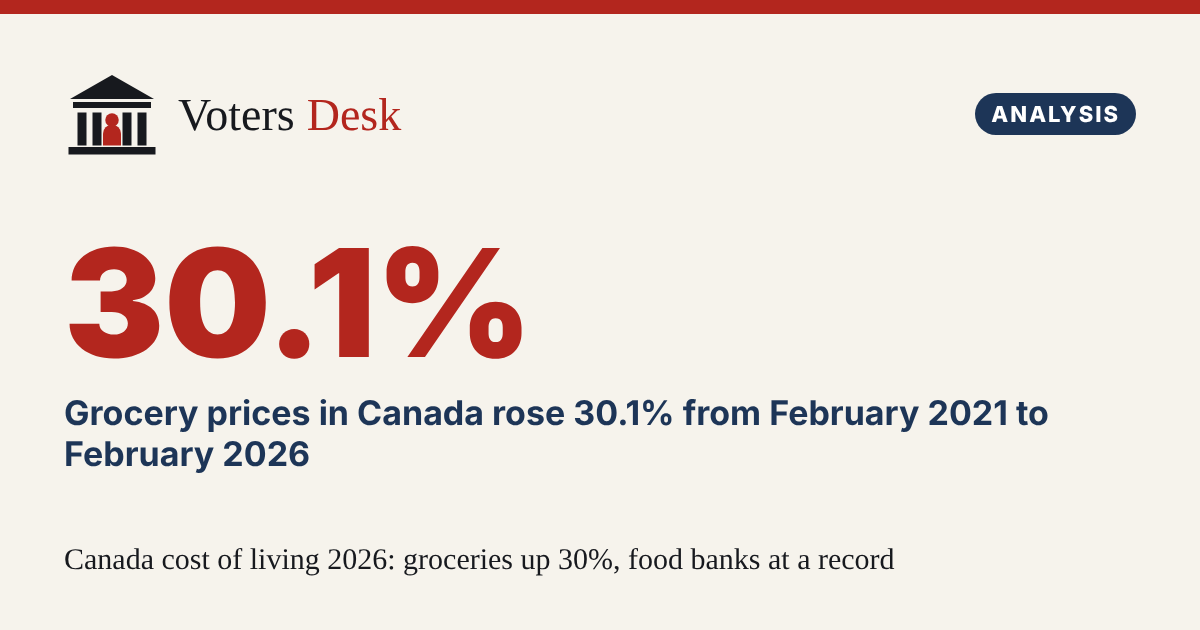
Grocery prices are up about 30 per cent in five years. Food bank visits hit a record 2.35 million in a single month, March 2026. And on November 1, Ontario cut the rebate on your hydro bill by a third. If your budget feels tighter every month, the numbers say you're not imagining it. Here's where the money is going, and which governments hold the levers.
30.1%
How much grocery prices rose from February 2021 to February 2026
Source: Statistics Canada
2.35M
Food bank visits in Canada in March 2026, a record and 117% more than in 2019
15.7%
Ontario Electricity Rebate from November 1, 2026, cut from 23.5%
Source: Ontario Regulation 328/26
$17,572
What a family of four is forecast to spend on food in 2026
Source: Canada's Food Price Report 2026
How much have grocery prices gone up in Canada?
A lot, and they never came back down. Statistics Canada reported that grocery prices rose 30.1 per cent between February 2021 and February 2026 (Statistics Canada). Inflation slowing doesn't mean prices fall. It means they rise more slowly from a higher starting point.
| 2022 | 9.8% |
|---|---|
| 2023 | 7.8% |
| 2024 | 2.2% |
2022 was the largest annual increase since 1981. Each year builds on the one before.
Source: Statistics Canada, food purchased from stores, annual change
The 2022 jump of 9.8 per cent was the largest since 1981 (Statistics Canada). In October 2026, grocery prices were still up 2.0 per cent from a year earlier (Statistics Canada).
Canada's Food Price Report, produced by Dalhousie University and partner universities, forecast that a family of four would spend $17,571.79 on food in 2026, up to $994.63 more than in 2025 (Dalhousie University). The report says food prices are 27 per cent higher than they were five years ago (Dalhousie University).
Who controls grocery prices in Canada?
No one controls them alone, but a few companies have a lot of power. The same report notes the top four grocery chains control at least 72 per cent of the national market (Dalhousie University). An industry-led, voluntary Grocery Code of Conduct took full effect on January 1, 2026, after Ottawa pushed the big chains to sign on (Global News). It deals with how grocers treat suppliers. It isn't meant to address retail food prices, and it doesn't cap them.
Transport costs feed straight into food prices, and they've soared. Statistics Canada found that the prices producers charged for diesel rose between 35.4 and 76.1 per cent from May 2025 to May 2026, depending on the region (Statistics Canada). Trucks move almost everything in a grocery store, and that cost ends up in what you pay at the till.
How many Canadians are using food banks?
More than ever. Food Banks Canada's HungerCount 2026 recorded 2.35 million visits in March 2026, up 8.7 per cent from the year before and 117 per cent since 2019 (CP24). One in three visits, nearly 776,000, were by children. For nearly 18 per cent of food bank clients, a job is their main source of income (Food Banks Canada).
| 2025 | 2.17M |
|---|---|
| 2026 | 2.35M |
2025: 2.166 million visits. 2026: more than 2.355 million.
Ontario has the most visits of any province. It recorded 846,724 food bank visits in March, up 10.9 per cent in a year and 149.3 per cent since 2019 (Food Banks Canada, HungerCount 2026).
Is my Ontario hydro bill going down?
The price per kilowatt-hour went down on November 1. Your bill may not fall at all, because the province cut its rebate at the same time. The Ontario Electricity Rebate dropped from 23.5 per cent to 15.7 per cent, by a regulation the government made on October 8, 2026 (Ontario Regulation 328/26).
For a typical household using 700 kWh a month, the Ontario Energy Board estimated the rebate at about $36 a month last year (Ontario Energy Board). After the cut, it's about $23 a month (NOW Toronto). That's roughly $13 a month, or about $156 a year, less help from the province for a typical home. That yearly figure is our own math from those two estimates.
| From Nov. 2025 | $36 |
|---|---|
| From Nov. 2026 | $23 |
Typical residential customer using 700 kWh per month.
The new time-of-use prices, set from November 1, 2026, are 18.9 cents on-peak, 14.6 cents mid-peak and 9.1 cents off-peak (Hydro One). Last winter they were 20.3, 15.7 and 9.8 cents (Ontario Energy Board).
The government's side: the energy minister's office pointed to electricity prices falling this winter and said the rebate still saves an average family nearly $275 a year (CP24). Prices are lower. The rebate has also moved before, between 13.1 and 23.5 per cent over the past five years. But a smaller rebate means the province spends less on bill relief, so you see less of the price drop than you would have if the rate had stayed at 23.5 per cent.
What about gas prices?
They spiked, and they're easing. Gasoline was up 30.9 per cent year over year in October, partly because prices were unusually low a year earlier (Statistics Canada). By November 18, pump prices had fallen to their lowest level since March (CP24). That's welcome. But the Bank of Canada cited the risk from high energy prices when it raised interest rates in October, and that hike won't reverse on its own when gas gets cheaper. Our piece on the rate hike covers it.
Are paycheques keeping up?
No. Average hourly wages rose 2.2 per cent in the year to October 2026 (Statistics Canada), while overall prices rose 3.1 per cent (Statistics Canada). When pay grows slower than prices, the average worker loses buying power, even if the number on the pay stub goes up.
Who is responsible for what?
- Ottawa (your MP): competition law and the grocery market, federal fuel excise tax, GST, Employment Insurance and federal benefits like the Canada Workers Benefit.
- The province (your MPP): the Ontario Electricity Rebate, provincial fuel tax, the HST's provincial portion, minimum wage, social assistance rates.
- Your city: water and sewer rates, transit fares and property taxes, which landlords pass on in rent.
Not sure who represents you? Find your MP, MPP and councillor.
What we think
This is our opinion, based on the figures above.
Nobody in government set out to make groceries cost 30 per cent more. Weather, war, trade fights and fuel did a lot of that. But governments make choices about how much of the pain they share. Ontario chose to shrink its hydro rebate the moment prices dipped. Ottawa oversees a grocery market where four chains control most of what we buy, and the industry's new code doesn't touch prices. Meanwhile 2.35 million times a month, someone walks into a food bank, and nearly one in five of them has a job.
People are entitled to ask a simple question of every level of government: when costs went up, what did you do for us, and when costs came down, who kept the difference?
What we couldn't confirm
We couldn't find a single official estimate of how much a typical Ontario hydro bill changed overall on November 1, after both the lower prices and the smaller rebate. It depends on your utility and how much you use. Your own bill is the best check.
Quick answers
- How much have grocery prices gone up in Canada?
- Statistics Canada reported that grocery prices rose 30.1 per cent from February 2021 to February 2026. They rose 9.8 per cent in 2022 alone, the largest annual increase since 1981.
- Why did the Ontario Electricity Rebate go down?
- Ontario cut the rebate from 23.5 per cent to 15.7 per cent on November 1, 2026, by regulation. The province pointed to lower electricity prices this winter. For a typical home the rebate fell from about $36 to about $23 a month.
- How many Canadians use food banks?
- Food Banks Canada recorded 2.35 million food bank visits in March 2026, a record, up 8.7 per cent from 2025 and 117 per cent since 2019. About a third of visits were by children.
Sources
- Statistics Canada: Consumer Price Index, February 2026
- Statistics Canada: Consumer Price Index, October 2026
- Statistics Canada: Inflation slowed in 2024 (grocery prices by year)
- Statistics Canada: Fuelling inflation
- Statistics Canada: Labour Force Survey, October 2026
- Ontario Regulation 328/26 (Ontario Electricity Rebate)
- Ontario Energy Board: November 2025 electricity prices
- Hydro One: Electricity prices from November 1, 2026
- NOW Toronto: Ontario electricity rates dropping, November 2026
- CP24: Ontario's electricity rates are falling this November
- Global News: Grocery code of conduct takes effect
- Dalhousie University: Canada's Food Price Report 2026
- Dalhousie University: Food Price Report 2026 news release
- Food Banks Canada: HungerCount 2026
- Food Banks Canada: HungerCount 2025
- CP24: Monthly food bank visits hit record high
- CP24: Gas prices hit lowest level since March
Spotted an error? We correct it and note the change at the top of the article. See how we work.
Discussion
Criticize decisions, votes and spending as hard as you like. Threats, slurs, personal attacks and accusations of crimes without a public record are removed. Comments with links or flagged words are reviewed before they appear.
Loading comments…
Get the facts in your inbox
One email with the week's budget and policy analysis, sources linked. Free. Unsubscribe any time.