AnalysisProperty taxMunicipal
Montreal property taxes up 9.8% in 2027. What do you get for it?
By VotersDesk · · 8 min read
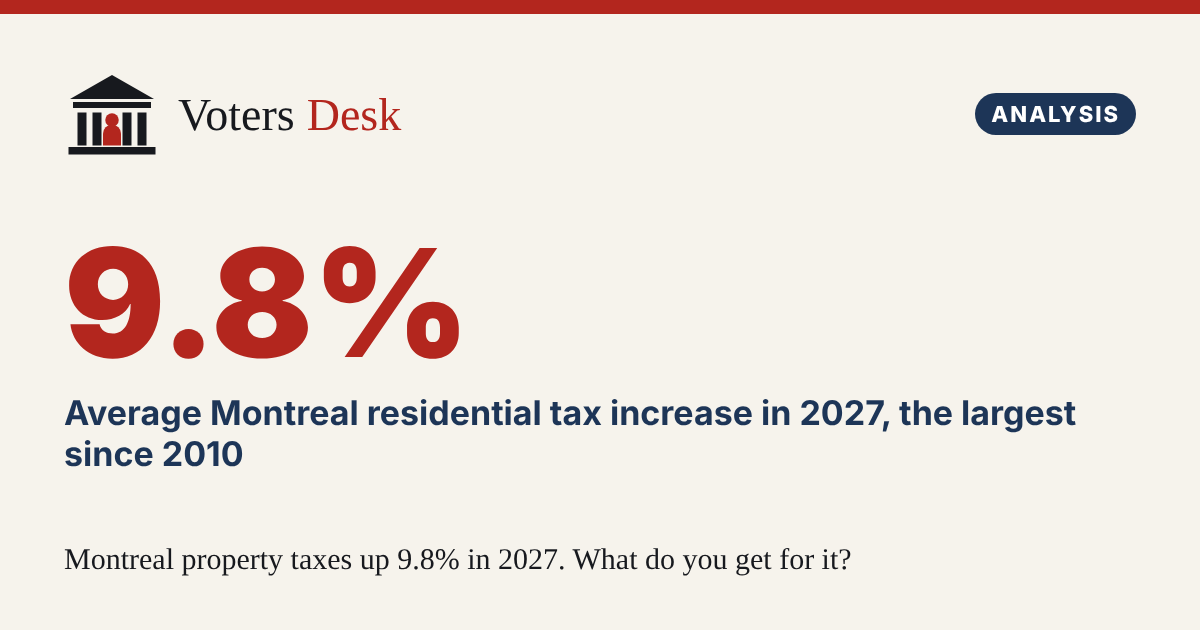
Montreal homeowners just got the biggest tax hike since 2010, according to Radio-Canada. The 2027 budget raises the average residential tax bill by 9.8 per cent, about $515 more for the average home. This comes from a mayor who campaigned on keeping increases in line with inflation. And while the bill goes up, several planned projects are being cancelled or pushed back. Here's what you're paying, where it goes, and what you're not getting.
9.8%
Average residential tax increase in Montreal's 2027 budget, the largest since 2010
Source: City of Montreal; Radio-Canada
$515
Extra tax on the city's average home ($827,376), from $5,277 to $5,791 a year
11.5%
Increase in Montréal-Nord, the hardest-hit borough
Source: Le Devoir
16%
Share of Montreal's annual budget spent repaying debt, according to the mayor
Source: The Canadian Press
How much are Montreal property taxes going up in 2027?
An average of 9.8 per cent for homes and 6.2 per cent for non-residential buildings, in an $8-billion operating budget tabled on November 24, 2026 (City of Montreal, Global News). The budget totals $8.044 billion, up 4.9 per cent (Narcity). Radio-Canada called it the largest tax increase since 2010 (Radio-Canada).
For the city's "average residence," valued at $827,376, the bill rises from $5,277 to $5,791, about $515 more, or roughly $43 a month. An average single-family home ($781,691) pays about $512 more, up 10.4 per cent. An average condo ($520,339) pays about $313 more, up 9.5 per cent (MTL Blog, using city figures).
| 2022 | 2.0% |
|---|---|
| 2023 | 4.1% |
| 2024 | 4.9% |
| 2025 | 2.2% |
| 2026 | 3.8% |
| 2027 | 9.8% |
Average increase in total residential tax charges, including borough taxes. 2022 to 2025 under Valérie Plante; 2026 and 2027 under Soraya Martinez Ferrada.
Source: CBC News and Global News coverage of each Montreal budget
The earlier figures come from coverage of each year's budget: 2 per cent in 2022 (CBC News), 4.1 per cent in 2023 (CTV News), 4.9 per cent in 2024 (Global News), 2.2 per cent in 2025 (CBC News) and 3.8 per cent in 2026 (Global News).
Didn't the mayor promise to keep taxes at inflation?
Yes. Martinez Ferrada had promised to limit tax hikes to the rate of inflation, and she said breaking it was necessary to balance an $8-billion budget (The Canadian Press). Her words when tabling the budget: "I want to begin by acknowledging that we are unable to honour our commitment to limit property tax increases to inflation" (CTV News).
Last year's bill was already above her campaign estimate. During the 2025 campaign, she put inflation at "around 2 per cent," but her first budget in January 2026 raised residential taxes by 3.8 per cent on average (Narcity). The city said the part of the increase under its control was 3.4 per cent, matching Montreal-area inflation from September 2024 to September 2025 (City of Montreal).
This year the general property tax adds 2.6 points to the increase. The new infrastructure tax adds 5.1 points on its own, more than half of the 9.8 per cent (Narcity).
Where does the extra $515 go?
More than half of it goes to one new tax. Here's how the city breaks down the increase for the average home (MTL Blog, using city figures):
| New infrastructure tax | $269 |
|---|---|
| General property tax | $137 |
| Water tax | $78 |
| Borough service taxes | $38 |
| Borough investment taxes | $7 |
| Debt tax, former cities | $-14 |
The debt tax for former cities falls by $14, shown as a negative value.
The new levy is 3.25 cents per $100 of assessed value on every building in the city. It raises $139 million in 2027 for a reserve fund to pay for infrastructure maintenance and renewal in cash, instead of borrowing (Les Affaires). Spending on water infrastructure, $587 million in 2026, is planned to reach $913 million by 2030 (Noovo). The 10-year capital plan puts $7.1 billion into water infrastructure, its largest single item (City of Montreal).
The mayor's side: "The reality is that Montreal can no longer afford to postpone essential investments. Every time we delay necessary maintenance, the cost is bigger," Martinez Ferrada said. She described the measures as "responsible and draconian" (The Canadian Press). Noovo quoted her this week saying the city's credit card has a limit, and the city's is completely maxed out. She used a similar line in January, tabling her first budget (Noovo, The Canadian Press).
Which Montreal boroughs are hit hardest?
The north, east and west ends of the island. Montréal-Nord leads at 11.5 per cent, followed by Lachine at 11.3 per cent and L'Île-Bizard–Sainte-Geneviève at 11.1 per cent. The smallest increases are in Ville-Marie, 8.7 per cent, and Côte-des-Neiges–Notre-Dame-de-Grâce, 8.2 per cent (MTL Blog, using city figures, CTV News).
| Montréal-Nord | 11.5% |
|---|---|
| Lachine | 11.3% |
| L'Île-Bizard–Sainte-Geneviève | 11.1% |
| Rivière-des-Prairies–Pointe-aux-Trembles | 10.9% |
| Pierrefonds–Roxboro | 10.6% |
| City average | 9.8% |
| Ville-Marie | 8.7% |
| Côte-des-Neiges–NDG | 8.2% |
The other 12 boroughs fall between 9.2 and 10.4 per cent.
Montréal-Nord gets the biggest percentage hike, in a borough where 12 per cent of residents have low incomes, compared with 11 per cent across Montreal (Centraide). For an average condo there, worth about $347,000, the bill rises by $263 (Le Devoir).
What do Montrealers get for the extra money?
Some new spending, and a list of things that won't happen. The budget includes $40 million for police body cameras and 52 more STM transit constables (Global News). The cameras won't start rolling out until 2028 (CBC News). Public security, mostly police, costs about $1.4 billion in 2027, or 17.5 per cent of the budget. The police budget is $917.4 million, which is less than the $939.2 million the force actually spent in 2026 (CBC News).
At the same time, several major projects have been cancelled or postponed, including the Grand parc de l'Ouest (Global News). In some cases, the 10-year capital plan has money only for 2027 and nothing after (CBC News).
The opposition's side: Projet Montréal leader Ericka Alneus said Montrealers will pay much more in taxes while investment in the city's development goes down, calling it "pay more to receive less" (Journal Métro).
Will renters pay too?
Probably, over time. Under the rent rules in force since January 2026, a landlord can get an extra adjustment when a building's municipal tax increase is higher than the tribunal's base percentage, 3.1 per cent for 2026 (Tribunal administratif du logement). A 9.8 per cent tax hike is well above that, so it can show up in rent increase notices. How much depends on the building, and tenants can refuse an increase and let the tribunal decide. We couldn't find an official estimate for the average tenant.
Who is responsible for what?
- Montreal city council and the mayor: the general tax rate, the new infrastructure levy, the water tax, police and city services, and the 10-year capital plan.
- Your borough council: borough service and investment taxes, which add to your bill and explain part of why the increase differs from borough to borough.
- Quebec: municipal law, the housing tribunal's rent rules, and transit funding through the STM's provincial support.
Find your elected officials on our directory. Ontario readers can compare with what GTA cities did in 2026.
What we think
This is our opinion, based on the figures above.
Nobody wants water mains bursting under their street, and paying for repairs in cash instead of piling on more debt is a defensible idea. But Montrealers were told, twice, that taxes would stay at inflation. Instead they got 3.8 per cent last year (the city says the 3.4 per cent under its control matched inflation) and 9.8 per cent this year, while groceries and rent already eat their paycheques. Admitting a broken promise isn't a plan.
The decades of underinvestment didn't start with this mayor, and voters should hold every administration that kicked the can to account. But the people paying for it now, especially in Montréal-Nord and Lachine, deserve more than an admission. They deserve to know exactly which streets, pipes and services the $139 million will fix, on what schedule, and what happens to the levy once the backlog is cleared.
What we couldn't confirm
The detailed breakdown of the increase and the borough list come from MTL Blog's summary of city budget figures; we couldn't check them line by line against the city's own 2027 budget documents, which are linked from montreal.ca. We couldn't find the total size of Montreal's infrastructure maintenance backlog in the 2027 budget coverage. City council is scheduled to vote on the budget in December.
Quick answers
- How much are Montreal property taxes going up in 2027?
- The average residential tax bill rises 9.8 per cent, about $515 for the city's average home valued at $827,376. Non-residential properties rise 6.2 per cent. Radio-Canada called it the largest increase since 2010.
- Why are Montreal taxes going up so much?
- Most of the increase comes from a new infrastructure levy of 3.25 cents per $100 of assessment, which raises $139 million for a reserve to pay for infrastructure repairs in cash. The general tax, water tax and borough taxes also rose.
- Which Montreal boroughs have the biggest tax increase in 2027?
- Montréal-Nord at 11.5 per cent, Lachine at 11.3 per cent and L'Île-Bizard–Sainte-Geneviève at 11.1 per cent. Côte-des-Neiges–Notre-Dame-de-Grâce has the smallest increase at 8.2 per cent.
Sources
- Global News: Montreal mayor announces 10% tax hike to address infrastructure backlog
- The Canadian Press: Montreal mayor announces 10 per cent tax hikes
- CBC News: Other takeaways from Montreal's 2027 budget
- CTV News: Montreal municipal taxes going up, hardest-hit boroughs
- Radio-Canada: La plus forte hausse de taxes depuis 2010
- MTL Blog: How much more Montreal homeowners will pay in 2027 (city figures)
- Le Devoir: Quelle sera votre hausse de taxes à Montréal en 2027?
- Les Affaires: Que prévoit le budget 2027 de Montréal?
- Noovo: Montréal présente un budget marqué par une hausse notable des taxes
- Journal Métro: Payer plus pour recevoir moins, dénonce Projet Montréal
- City of Montreal: Budget 2027 et PDI 2027-2036
- City of Montreal: Montréal présente son budget 2027
- Narcity: Hausse de taxes municipales à Montréal en 2027
- Tribunal administratif du logement: Regulatory changes on rent fixing
- Centraide: Montréal-Nord neighbourhood profile
- The Canadian Press: Montreal 2026 budget
- CTV News: Montreal hikes residential taxes 4.1 per cent (2023)
- City of Montreal: 2026 budget release
- Narcity: Budget 2026, hausse de taxes moyenne de 3,8 %
- Global News: Montreal 2026 budget
- CBC News: Montreal 2025 budget
- Global News: Montreal 2024 budget
- CBC News: Montreal 2022 budget
Spotted an error? We correct it and note the change at the top of the article. See how we work.
Discussion
Criticize decisions, votes and spending as hard as you like. Threats, slurs, personal attacks and accusations of crimes without a public record are removed. Comments with links or flagged words are reviewed before they appear.
Loading comments…
Get the facts in your inbox
One email with the week's budget and policy analysis, sources linked. Free. Unsubscribe any time.