AnalysisProperty taxMunicipal
GTA property tax increases 2026 compared: Toronto, Mississauga, Brampton, Burlington, Oakville
By VotersDesk · · 6 min read
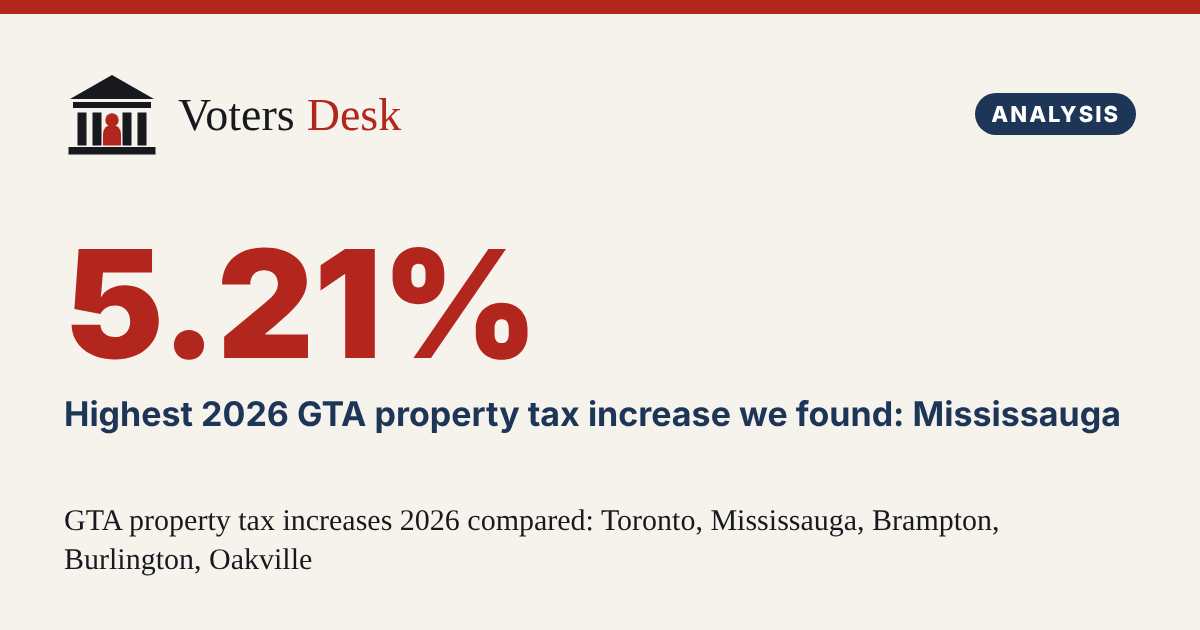
Every city in the GTA told residents its 2026 budget was affordable. The increases on the actual tax bill ranged from under 2 per cent to over 5. The bigger story is how each city chose to present its number, and how much of each increase came from governments the city doesn't control.
5.21%
Mississauga, total residential increase (city 1.61 + Peel Region 3.60)
Source: City of Mississauga
4.5%
Burlington, total increase including Halton Region and education
Source: City of Burlington
2.2%
Toronto, municipal increase including the City Building Fund levy
Source: City of Toronto
1.96%
Oakville, total tax increase, plus a new separate stormwater fee of $137 for a detached home
Source: Town of Oakville
Which GTA city raised property taxes the most in 2026?
Of the cities we checked, Mississauga had the largest published increase at 5.21 per cent, followed by Burlington at 4.5 per cent and Brantford, just outside the GTA, at 4.22 per cent in its mayor's budget. Toronto came in at 2.2 per cent and Oakville at 1.96 per cent.
| Mississauga | 5.21% |
|---|---|
| Burlington | 4.50% |
| Brantford | 4.22% |
| Toronto | 2.20% |
| Oakville | 1.96% |
Not a perfect like-for-like comparison. Burlington and Oakville include education; Mississauga includes city and Peel Region; Toronto is the single-tier municipal rate; Brantford is the mayor's budget including agencies. Oakville moved stormwater costs to a separate fee. Brampton did not publish a combined figure.
Source: City budget releases: Mississauga, Burlington, Brantford, Toronto, Oakville (linked in Sources)
Brampton is missing from the chart for a reason: the city announced a 0 per cent increase on its own portion plus a 1 per cent hospital levy (about $73 on the average home), but didn't publish the combined change including Peel Region (City of Brampton).
Why are the published numbers hard to compare?
Because each city chooses which number to lead with. We found four common moves:
- Leading with the city's share, not the total. Mississauga's budget grew 4.39 per cent, but the city led with its 1.61 per cent share of the bill (City of Mississauga). Burlington's budget grew 5.81 per cent; its share of the bill increase was 2.98 per cent (City of Burlington). Both cities also publish the total, to their credit.
- Moving costs into fees. Oakville shifted stormwater out of the tax levy into a new fee, estimated at $137 a year for a detached home (Town of Oakville). For an $800,000 detached home, our calculation from the town's figures puts the tax increase plus the fee at about 4 per cent.
- Separate levies. Toronto's City Building Fund and Brampton's hospital levy are both tax increases with their own name. In 2025, Toronto's release described a 5.4 per cent increase (City of Toronto); with the 1.5 per cent levy, homeowners paid 6.9 per cent (CBC News).
- The election-year dip. Toronto's 2.2 per cent was the lowest since Olivia Chow became mayor in 2023, after 9.5 per cent in 2024 and 6.9 per cent in 2025. Ontario's municipal elections were held in October 2026.
None of this is illegal or even unusual. But a resident comparing headlines would get the wrong picture almost every time.
What is the biggest single driver across the region?
Policing. In Peel, police accounted for 1.77 points of the region's 3.36 per cent increase, more than all other regional services combined (Peel Region). In Toronto, the police budget funded by property tax (the net figure) grew 7 per cent, while the city's total gross tax-supported spending grew about 1 per cent; the measures differ, but the gap is wide (Social Planning Toronto; City of Toronto). In Halton, the region's 4.6 per cent increase covered regional and police services together (Oakville News).
Police boards set their own budgets, and councils have limited power to cut them line by line. That makes the vote on the total police budget one of the most important a councillor casts all year, and one of the least discussed.
How much do upper levels of government push onto property tax?
A lot. Toronto says 27 per cent of its property tax, $1.6 billion, pays for programs that are provincial or federal responsibilities (City of Toronto). Brampton's hospital levy exists because the province requires a local share of hospital construction (City of Brampton). And every bill in Ontario is still calculated on 2016 assessments because the province has postponed reassessment year after year (MPAC; our explainer).
The one number to ask for
Ask your city for the total change in what an average household pays it, all taxes and levies and new fees together, compared with last year. If a city can't or won't give that in one line, that tells you something too.
City-by-city analysis
Quick answers
- Which GTA city had the highest property tax increase in 2026?
- Of the cities we checked, Mississauga had the largest published residential increase at 5.21 per cent, combining a 1.61 per cent city share and 3.60 per cent from Peel Region. Burlington followed at 4.5 per cent.
- What was Toronto's property tax increase in 2026?
- 2.2 per cent: a 0.7 per cent operating increase plus a 1.5 per cent City Building Fund levy, or about $91.53 more on a home assessed at $692,140.
- Why are city tax increases hard to compare?
- Cities lead with different numbers. Some publish only their own share, some include regional and education taxes, some move costs into new fees, and some add separately named levies. Ask for the total change an average household pays.
Sources
- City of Mississauga: 2026 Budget adopted
- City of Burlington: Understanding your property tax bill
- City of Toronto: 2026 Budget Summary
- Town of Oakville: Council approves 2026 budget
- City of Brantford: Mayor's 2026 Budget
- City of Brampton: 2026 Budget adopted
- Peel Region: 2026 Budget Overview
- City of Toronto: 2026 budget launch
- Social Planning Toronto: 2026 budget launch analysis
- Oakville News: stormwater fee and 2026 tax increase
Spotted an error? We correct it and note the change at the top of the article. See how we work.
Discussion
Criticize decisions, votes and spending as hard as you like. Threats, slurs, personal attacks and accusations of crimes without a public record are removed. Comments with links or flagged words are reviewed before they appear.
Loading comments…
Get the facts in your inbox
One email with the week's budget and policy analysis, sources linked. Free. Unsubscribe any time.