AnalysisEconomyFederal
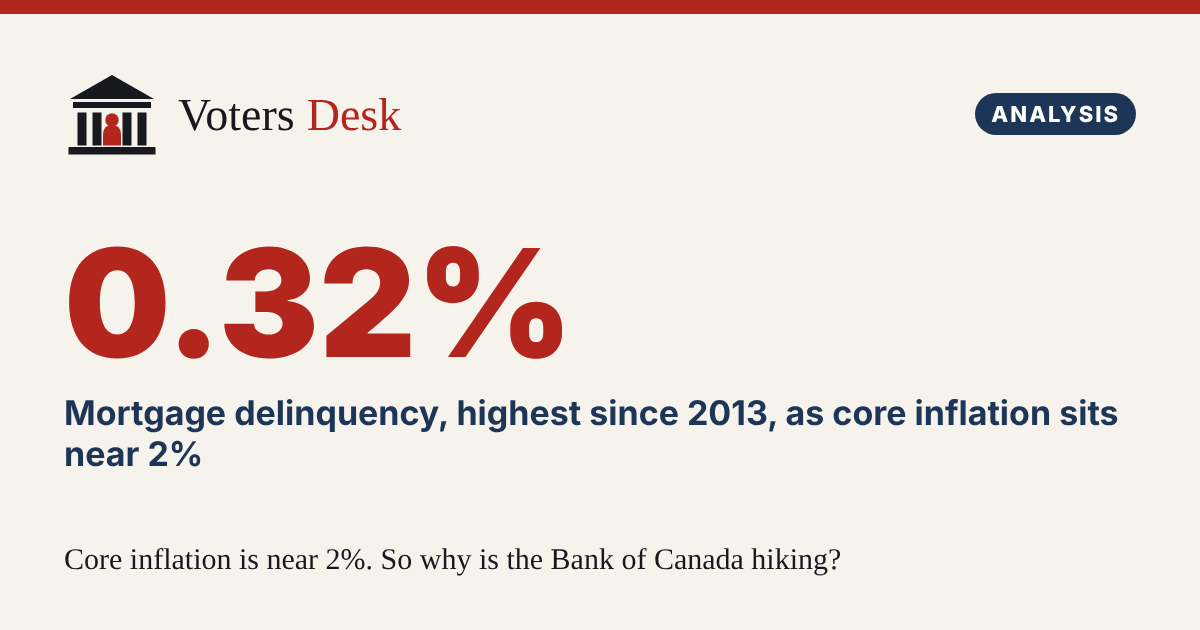
Core inflation is near 2%. So why is the Bank of Canada hiking?
By VotersDesk · · 9 min read
Mortgage delinquency in Canada just hit its highest level since Equifax started tracking it in 2013. The Bank of Canada raised rates in October and markets expect it to do it again on December 9. In the same week, the Bank changed which inflation gauges it says it will lean on. If that combination makes you suspicious, you're not alone: the Bank's own review found Canadians are losing faith in official inflation numbers. So we went back to first principles and checked each claim against the data.
0.32%
Mortgage balances 90+ days behind in Q3 2026, the highest since tracking began in 2013, up 31.1% in a year
Source: Equifax Canada
1.8%
CPI-trim in October, one of the Bank's own core inflation gauges, below its 2% target
Source: Statistics Canada, via The Hub
3.1%
Headline inflation in October, pushed up by gasoline, which was 30.9% higher than a year earlier
$1.28B
Extra interest per year on variable mortgages and home equity lines from each quarter-point hike (our sum of Equifax figures)
Source: Equifax Canada
Did the Bank of Canada change how it measures inflation?
Partly. The target did not change: it's still 2 per cent on the total consumer price index, renewed with Ottawa on November 5 for five more years, to December 31, 2031 (Bank of Canada). What changed is the set of "core" gauges the Bank uses to read the trend underneath the noise.
On November 24, Governor Tiff Macklem told the Economic Club of Canada that the Bank's main core measures will now be CPI-trim and CPIX (BNN Bloomberg). CPI-median, which the Bank leaned on for years, is no longer on that list. CPIX isn't new. It guided policy from 2001 to 2016 (e2gold, citing BNN Bloomberg and CTV News). It removes eight fixed groups of volatile items, including gasoline, mortgage interest costs, and fruits and vegetables (BNN Bloomberg).
Macklem also admitted the Bank caused confusion when it talked up measures that strip out food and gas, since those are big household costs. He said total CPI is the target and will be central to all its communication, and the Bank will publish an inflation dashboard on its website (BNN Bloomberg).
The wording around jobs changed too. The 2021 agreement said the Bank should "actively seek" maximum sustainable employment "when conditions warrant", and it named climate change and inequality as challenges. The 2026 version gets "back to basics," in the words of a C.D. Howe Institute memo, with inflation as the clear primary goal (C.D. Howe Institute, Department of Finance, 2021). The new statement still says low inflation "supports maximum sustainable employment," but climate isn't mentioned at all (Bank of Canada).
Why does this matter to you? Because the Bank's own consultations found Canadians increasingly skeptical of inflation measures that don't match what they pay at the till (Financial Post, via Yahoo Finance). Macklem said Canadians found the old core measures confusing.
Did the new gauges make inflation look worse to justify hikes?
No, and this is the part most people miss. By the Bank's own core gauges, underlying inflation is at or below target. In October, CPI-trim was 1.8 per cent, CPI-median was 2.0 per cent and inflation excluding energy was 2.0 per cent (The Hub). Desjardins reported that the older measures, including CPIX, rose even more slowly than trim and median (Desjardins).
| Headline CPI (the target) | 3.1% |
|---|---|
| CPI-common | 2.5% |
| CPI excluding energy | 2.0% |
| CPI-median | 2.0% |
| CPI-trim | 1.8% |
The 2% target sits on total CPI. CPIX was not published in the coverage we could find; Desjardins said it rose more slowly than trim and median.
Source: Statistics Canada, Consumer Price Index, October 2026, via The Hub and ActionForex
So the gap between 3.1 per cent and roughly 2 per cent is mostly gasoline. Pump prices were 30.9 per cent higher than a year earlier, partly because prices were unusually low in October 2025 (The Canadian Press).
What did change is emphasis. By putting total CPI at the centre of everything it says, the Bank appears to be signalling that it's less willing to look past high gas prices than it used to be. That's a real shift, and it leans toward higher rates, not lower ones.
How is a rate hike supposed to bring prices down?
Start from the basics. The Bank sets one rate: what banks pay to borrow overnight. Banks set their prime rate off it, and prime sets the cost of variable mortgages, credit lines and many business loans. When borrowing costs more, households and businesses spend less. Less spending means less pressure on prices, and businesses think twice before raising theirs.
Notice what's missing from that chain: oil. A higher rate in Ottawa does not change the world price of a barrel. Macklem said it himself in September: monetary policy "cannot reverse tariffs or change the price of gasoline" (Bank of Canada). The Bank's argument is about the second round. It worries that high fuel costs will spread into the price of everything that gets trucked, flown or heated, and that businesses will raise prices expecting more inflation. On November 24, Macklem warned that cost pressures on businesses are building, and BMO now expects a hike to 2.75 per cent on December 9 (Global News).
The catch is that the tool works by squeezing demand. The squeeze is the mechanism, not a side effect.
Is mortgage delinquency rising, and does the Bank want that?
It's rising, steadily. Equifax says 0.32 per cent of mortgage balances were three or more months behind in the third quarter of 2026, up 31.1 per cent from a year earlier and the highest since it began tracking in 2013. It was the sixteenth straight quarterly increase, and Ontario and B.C. accounted for 91 per cent of the growth in severely late accounts (Equifax Canada).
The banks' own count tells the same story. Mortgages in arrears at the big banks more than doubled from a low of 0.14 per cent in August 2022 to 0.30 per cent in August 2026 (Canadian Bankers Association, Benchmark Canada). Stress is far higher at non-bank lenders that serve people the banks turn away: CMHC put mortgage investment entities at 2.25 per cent in early 2026, against 0.28 per cent at chartered banks (Pekoe, citing CMHC).
| Aug 2022 (low) | 0.14% |
|---|---|
| Aug 2026 | 0.30% |
Chartered banks only. Non-bank lenders run much higher. Still low by G7 standards.
Source: Canadian Bankers Association
These are small percentages in absolute terms, and Canada still ranks among the lowest in the G7 (Benchmark Canada). But the direction is clear. Equifax told The Canadian Press it expects delinquency to ease around the middle of 2027 if rates stay flat, and warned that another hike would add pressure (CP24).
Does the Bank want people missing payments? We found nothing that says so, and its own Financial Stability Report treats borrower distress as a risk to watch (Bank of Canada). The honest answer is harsher in a different way: the Bank wants spending to slow, and it accepts that some households will be hurt to get there. Who gets hurt is not random. About 1.4 million variable-rate mortgages and 1.3 million home equity lines over $50,000 feel a hike within weeks. Equifax says a hike could affect nearly one in four mortgage holders (Equifax Canada).
Do higher interest rates benefit the banks?
Some of the money does flow to lenders. Equifax estimates each quarter-point hike adds about $860 million a year in interest on variable mortgages and $419 million on home equity lines (Equifax Canada). That's about $1.28 billion, by our addition, landing with banks, credit unions and other lenders. BMO's Canadian banking arm reported wider margins earlier this year in what it called a higher-for-longer rate world (Insurance Business).
But it isn't a one-way street. Banks also pay more on savings accounts and GICs when rates rise, and they have to set aside more for loans that go bad. RBC's provision for credit losses rose to $1.00 billion in its third quarter from $881 million a year earlier (Royal Bank of Canada). And much of the banks' recent profit growth has come from wealth management and capital markets, not mortgages (BNN Bloomberg). The Big Six still made $69.86 billion in fiscal 2025 (The Canadian Press, via CP24). We break that down in our bank profits article.
Outside the banks, people with savings and no debt earn more when rates rise, and people who borrow pay more.
Does the Bank of Canada fund wars and police budgets?
No. The Bank doesn't decide what governments spend. Defence spending is set by Parliament: Canada spent $63.4 billion on defence in 2025 by NATO's count, more than the $57.4 billion Ottawa sends provinces for health care this year (our defence spending analysis). Police budgets are set by city councils and police boards, and they show up on your property tax bill (Toronto, Montreal).
Where the two connect is indirect. The Bank looks at total demand in the economy, and government spending is part of that. If governments spend heavily while the Bank is trying to cool prices, the Bank may keep rates higher than it otherwise would. That's a fair question to put to the people who set budgets. It's not evidence that the Bank raises rates to pay for wars or police.
Who is getting squeezed?
Working people with debt, mostly. Wages rose 2.2 per cent over the year to October while prices rose 3.1 per cent, and unemployment sits at 6.7 per cent, with youth unemployment at 13.7 per cent (our October rate hike analysis). Total consumer debt reached $2.74 trillion. Late payments on credit cards and other loans rose 9.8 per cent among people with mortgages, while they improved 3.4 per cent among people without one (Equifax Canada). That gap suggests some homeowners are falling behind on other bills to keep up with the house.
What we think
This is our opinion, based on the figures above.
The Bank did not cook the books. The core gauges it says it will lean on, old and new, put underlying inflation around 2 per cent. That's exactly why its next move deserves scrutiny. Raising rates again would mean squeezing Canadians to head off a spread of fuel costs that the Bank's own gauges don't yet show, in an economy with 6.7 per cent unemployment and record mortgage arrears.
We also think the Bank is right about one thing: people judge inflation by groceries, gas and rent, not by a trimmed mean. Putting total CPI front and centre is more honest. But honesty cuts both ways. If total CPI is what counts, the Bank should say just as plainly who pays for its cure: variable-rate borrowers, people renewing in 2027, and young families in Ontario and B.C. A central bank that's independent of politicians still owes the public a clear account of who wins and who loses.
What we couldn't confirm
We could not find the October CPIX reading itself, only Desjardins' description that it rose more slowly than CPI-trim and CPI-median. We could not find the Bank's stated reason for dropping CPI-median. The background documents behind the renewal were not yet public when C.D. Howe wrote its memo. We found no evidence that the Bank sets rates to help bank profits or to fund government spending, and we don't claim it does.
Quick answers
- Did the Bank of Canada change how it measures inflation in 2026?
- The 2% target on total CPI did not change. In November 2026 the Bank said its main core gauges are now CPI-trim and CPIX, an older measure it used from 2001 to 2016, and CPI-median is no longer on that list. It also said total CPI will be central to its communication.
- What is CPIX?
- CPIX is a core inflation measure that removes eight fixed groups of volatile items, including gasoline, mortgage interest costs, and fruits and vegetables. It guided Bank of Canada policy from 2001 to 2016.
- Why is the Bank of Canada raising rates if core inflation is near 2%?
- Headline inflation was 3.1% in October because of gasoline. The Bank says it wants to stop high energy costs spreading to other prices. Its core gauges were near 2%: CPI-trim 1.8% and CPI-median 2.0%.
- How high is mortgage delinquency in Canada?
- Equifax says 0.32% of mortgage balances were 90 or more days behind in the third quarter of 2026, up 31.1% in a year and the highest since it began tracking in 2013. Ontario and B.C. drove most of the increase.
- Do banks make more money when interest rates go up?
- Partly. Equifax estimates each quarter-point hike adds about $860 million a year in interest on variable mortgages and $419 million on home equity lines. Banks also pay more on deposits and set aside more for bad loans when delinquency rises.
Sources
- Bank of Canada: Joint statement on the renewal of the monetary policy framework (2026)
- Department of Finance: Joint statement on the renewal of the monetary policy framework (2021)
- BNN Bloomberg: Macklem admits mixed messaging on core inflation
- Financial Post, via Yahoo Finance: Bank of Canada to maintain 2% inflation target
- e2gold (citing BNN Bloomberg and CTV): Bank of Canada revives CPIX
- C.D. Howe Institute: The Bank of Canada got its framework renewal right, but questions remain
- Bank of Canada: Navigating uncertainty and adapting to change (September 2026)
- The Hub: Inflation holds at 3.1% in October
- The Canadian Press: Inflation unchanged at 3.1% in October
- Desjardins: Canada CPI, October 2026
- Global News: Bank of Canada expected to hike next month
- Equifax Canada: Q3 2026 consumer credit trends
- CP24 (The Canadian Press): Mortgage delinquency rate up 31% in Q3
- Benchmark Canada: Mortgage delinquencies (CBA data)
- Canadian Bankers Association: Mortgages in arrears
- Pekoe: Mortgage arrears in Canada 2026 (CBA and CMHC data)
- CMHC: Residential Mortgage Industry Report, Fall 2026
- Bank of Canada: Financial Stability Report 2026, households
- Insurance Business: BMO Q1 profit rises in higher-for-longer rates
- Royal Bank of Canada: Third Quarter 2026 Results
- BNN Bloomberg: Canadian bank profits tied to stocks
- CP24 (The Canadian Press): Big Six banks report fiscal 2025 profits
Spotted an error? We correct it and note the change at the top of the article. See how we work.
Discussion
Criticize decisions, votes and spending as hard as you like. Threats, slurs, personal attacks and accusations of crimes without a public record are removed. Comments with links or flagged words are reviewed before they appear.
Loading comments…
Get the facts in your inbox
One email with the week's budget and policy analysis, sources linked. Free. Unsubscribe any time.