AnalysisBudgetsAll levels
Police and defence budgets surge while schools, ERs and courts fall behind
By VotersDesk · · 9 min read
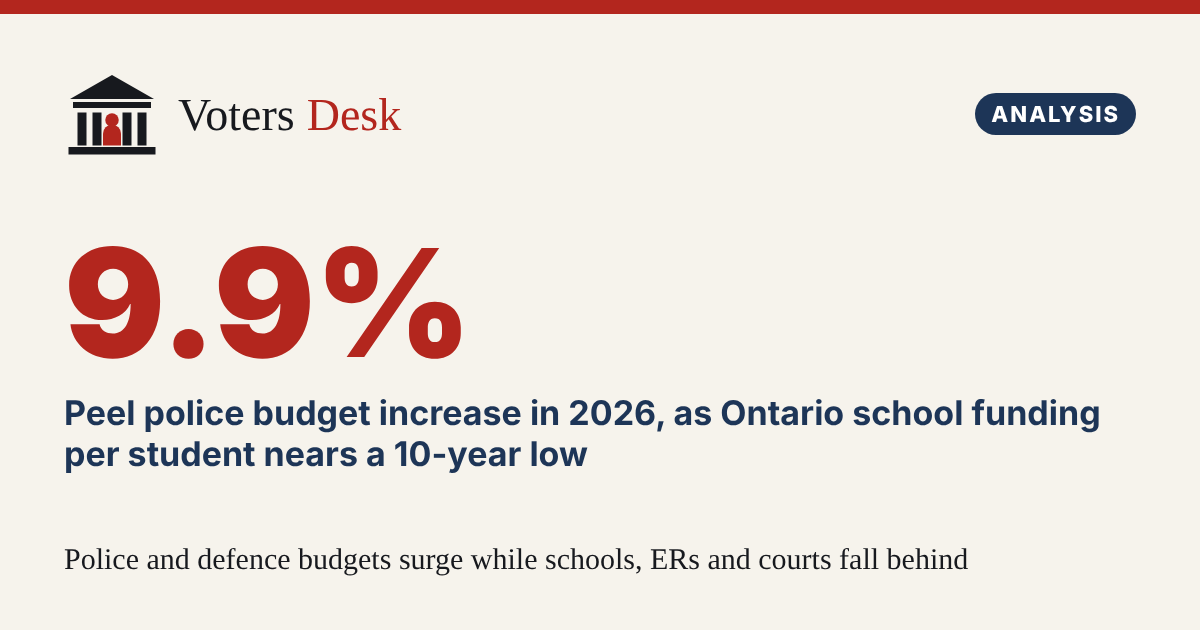
Peel's police budget is up 9.9 per cent this year. Toronto's is up about 7 per cent and Ottawa's police levy rose by the most in 15 years. The federal government has committed $8.5 billion in military aid to Ukraine and spent $63.4 billion on defence last year. Meanwhile Ontario's school funding per student is near a 10-year low, admitted ER patients wait most of a day for a bed, and most criminal cases in Ontario end before anyone goes to trial. Half the people in one 2026 survey said they had put off a bill to buy groceries. Here's what the numbers show about where the money goes, and what they don't show.
9.9%
Increase in Peel Regional Police's 2026 budget, to $837.3 million, on top of 23.3% the year before
Source: Peel Police Service Board
$15,140
Real provincial operating funding per Ontario student in 2025-26, the second lowest in 10 years
58%
Share of violent crime cases in Canada that were stayed or withdrawn, 2023-24
50%
Share of people in a 325-person survey who delayed a bill to pay for groceries or other necessities
Are families choosing between food and the mortgage?
Many are making that kind of trade-off. In Spergel's 2026 survey of 325 Canadians, half said they had delayed paying a bill so they could buy groceries or other necessities, and 52 per cent said they had worried about running out of food (Spergel). That's a small sample, so treat it as a signal, not a census. A larger Salvation Army survey of more than 1,500 people found 31 per cent have cut back on food because they can't afford groceries, up from 27 per cent a year earlier (Gander Beacon).
The credit data points the same way. Equifax found late payments on cards and other loans rose 9.8 per cent among people with mortgages over the past year, while they improved for people without one, and mortgage delinquency hit its highest level since Equifax began tracking it in 2013 (Equifax Canada). Rate hikes don't cause missed payments directly. They raise the payment, and the household has to find the money somewhere. We covered that in our Bank of Canada analysis.
How fast are police budgets growing?
Faster than inflation, across the Greater Toronto Area and Ottawa. Peel Regional Police's 2026 budget is $837.3 million, up $75.4 million or 9.9 per cent, with 175 new officers and 25 civilians (Peel Police Service Board). That followed a 23.3 per cent increase in 2025, and Peel's budget is up 81 per cent from $462.5 million in 2021 (The Pointer).
Toronto added $93.8 million, bringing its police budget to $1.43 billion (Toronto Life, CBC News). That's about 7 per cent, by our arithmetic. In Ottawa, the 5 per cent police levy increase is the largest in 15 years, according to Mayor Mark Sutcliffe (CTV News).
| Peel Regional Police | 9.9% |
|---|---|
| Toronto Police (our arithmetic) | 7.0% |
| Ottawa police tax levy | 5.0% |
| Inflation, October 2026 | 3.1% |
Toronto: $93.8 million added to reach $1.43 billion. Ottawa figure is the increase in police taxation revenue.
Source: Peel Police Service Board, CBC News, CTV News, Statistics Canada
Why? The forces themselves point to population growth, hiring plans and pay raises. About 90 per cent of Toronto's police budget is salaries and benefits (CBC News), and 90 per cent of Peel's increase is wages (Peel Police Service Board). Toronto's mayor defended the increase while saying crime continues to go down in the city (Toronto Life).
Some readers believe police budgets grow because governments expect unrest when the economy turns. We found no budget document that says so. What the documents do show is that police spending keeps climbing even in years cities call tight. Social Planning Toronto calls it the one budget line that never stops growing (Social Planning Toronto).
If police get more, why are court cases collapsing?
Because arrests and trials are paid for by different budgets. Police are funded mostly by cities. Courts and Crown prosecutors are run by the province. You can hire 175 officers and still lose the case if there's no judge, courtroom or prosecutor ready within the time limit.
That limit comes from the Supreme Court's 2016 Jordan decision: 18 months in provincial court and 30 months in superior court (The Globe and Mail). Across Canada, 58 per cent of violent crime cases were stayed or withdrawn in 2023-24, according to Statistics Canada data analysed by University of Guelph professor Dave Snow (The Hub). Not all of those are delay; charges get withdrawn for many reasons. But a federal justice department report found that 48 per cent of Ontario cases at risk of passing the Jordan limits in 2023-24 were stayed or withdrawn, second only to the Northwest Territories, though the data can't show that delay caused them (Justice Canada). CBC Toronto reported in 2024 that most criminal cases in Ontario, 56 per cent in 2022-23, ended with charges withdrawn, stayed or dismissed before trial (CBC News).
So the system is spending more at the front door, and losing cases at the back.
How much is Canada spending on defence and Ukraine?
A lot, and it's growing. Canada spent $63.4 billion on defence in 2025 by NATO's count, more than the $57.4 billion federal health transfer to the provinces this year (our defence analysis).
On Ukraine, Ottawa says it has committed more than $8.5 billion in military assistance since February 2022, as part of about $25.5 billion in total aid (The Canadian Press, via CP24). About $2 billion of military aid is set for 2026-27, mostly from money already approved in Budget 2025 (National Defence). A big share of the total is loans, not gifts: $11.55 billion went through an IMF account for Ukraine, and Canada's $5 billion G7 loan is to be repaid from revenues on immobilized Russian assets (Global Affairs Canada).
One fair comparison: Ontario's fiscal watchdog estimates the province's school system will be about $2.0 billion short by 2028-29 just to keep today's service levels (our school boards analysis). That's roughly one year of Canada's military aid to Ukraine. They come from different governments, so cutting one doesn't automatically fund the other. But both are choices made by people you vote for.
Are health care, schools and roads really getting worse?
On the measures we checked, yes.
- Emergency rooms: In January 2026, admitted patients in Ontario spent an average of 20.3 hours in the ER before getting a bed, and only 26 per cent got one within the eight-hour target (our ER analysis).
- Schools: Real provincial operating funding per student was $15,140 in 2025-26, the second lowest in 10 years, and eight boards were run by provincial supervisors as of mid-2026 (our school boards analysis).
- Traffic: Toronto drivers lost about 100 hours to rush-hour congestion in 2025, nearly four hours more than in 2024, according to TomTom. Only Vancouver was worse in Canada (Global News).
Note that a different traffic study, by Inrix, found Toronto congestion down 3 per cent in 2025 (Global News). The two measure different things, so the direction depends on whose numbers you use.
Is everything else being cut?
Not everything, and it's worth being precise. Many budgets grow in dollars every year. The question is whether they grow as fast as costs and population. For Ontario schools, they haven't: per-student funding after inflation is near a 10-year low (our school boards analysis). For hospitals, waits keep getting longer. Police budgets, by contrast, have been growing well above inflation in the region's biggest forces.
That's the pattern the data supports: some lines keep winning, others fall behind once you account for inflation and growth.
What we think
This is our opinion, based on the figures above.
Budgets are moral documents. When a region adds 9.9 per cent to policing after a 23.3 per cent jump, while schools are near a 10-year low and courts let cases expire, that tells you what the people in charge think matters. We don't claim anyone is planning for unrest; we have no evidence of that. We do think it's fair to ask why policing keeps getting priority over the things that prevent crime and keep it from collapsing in court: schools, mental health care, housing and enough judges and prosecutors to finish cases.
Defence and Ukraine are real commitments with real reasons behind them, and Canada signed up to NATO targets. But when families are cutting food to keep up with their mortgage, every government should be able to explain, in plain numbers, why its spending choices are the right ones. Most can't, or won't.
What we couldn't confirm
We found no official source tying police budget increases to expected economic unrest, so we don't claim it. Toronto's 7 per cent is our arithmetic from the $93.8 million increase and the $1.43 billion total. The 58 per cent figure covers all reasons for stays and withdrawals, not only delay. The Spergel survey is small, 325 people, and the Salvation Army figure comes from a news report of its study.
Quick answers
- How much did police budgets increase in 2026?
- Peel Regional Police rose 9.9% to $837.3 million after 23.3% in 2025. Toronto added $93.8 million to reach $1.43 billion, about 7%. Ottawa raised its police levy 5%, the largest increase in 15 years according to the mayor.
- Why are so many criminal cases in Ontario stayed or withdrawn?
- The Supreme Court's Jordan decision sets limits of 18 months in provincial court and 30 months in superior court. Courts and prosecutors are funded by the province, and when cases run past the limits they can be stayed. A federal report found Ontario had the second-highest share of at-risk cases that were stayed or withdrawn, though it cannot confirm delay was the cause.
- How much military aid has Canada given Ukraine?
- Ottawa says it has committed more than $8.5 billion in military assistance since February 2022, within about $25.5 billion in total aid. A large part of the total is loans.
- Is Ontario school funding going down?
- After inflation, yes. The Financial Accountability Office says real provincial operating funding per student was $15,140 in 2025-26, the second lowest in 10 years, and projects a $2.0 billion shortfall by 2028-29 to keep current service levels.
Sources
- Peel Police Service Board: 2026 police budget report
- Peel Police Service Board: 2026 budget technical briefing
- The Pointer: Peel police 9.9% hike approved, 81% jump in six years
- Toronto Life: Toronto's police budget has reached $1.43 billion
- CBC News: Toronto police request $93M budget increase in 2026
- CBC News: Toronto police seeking $46.2M budget increase (2025)
- CTV News: Ottawa Police Service Board approves 2026 budget
- CTV News: Ottawa mayor pitches 3.75% tax increase, biggest hike for police in 15 years
- Justice Canada: Criminal court case indicators related to the Jordan timelines
- Social Planning Toronto: 2026 police budget
- The Hub: Nearly 60% of violent crime cases are stayed or withdrawn
- The Globe and Mail: Court delays in sex-assault cases increase
- CBC News: Most criminal cases in Ontario now ending before trial
- The Canadian Press, via CP24: Ottawa to supply Ukraine with ammunition, winter clothing, food
- National Defence: Canada reaffirms support for Ukraine (February 2026)
- Global Affairs Canada: Assistance for Ukraine
- Spergel: The Cost of Getting By in Canada, 2026 survey
- Gander Beacon: Salvation Army survey on skipping meals
- Equifax Canada: Q3 2026 consumer credit trends
- Financial Accountability Office of Ontario: Ministry of Education estimates 2026
- Ontario Health: Time spent in emergency departments
- Global News: Toronto drivers spent more than 100 hours in traffic in 2025
- Global News: Inrix traffic congestion rankings 2025
Spotted an error? We correct it and note the change at the top of the article. See how we work.
Discussion
Criticize decisions, votes and spending as hard as you like. Threats, slurs, personal attacks and accusations of crimes without a public record are removed. Comments with links or flagged words are reviewed before they appear.
Loading comments…
Get the facts in your inbox
One email with the week's budget and policy analysis, sources linked. Free. Unsubscribe any time.