AnalysisBudgetsAll levels
Canada pledged billions to EV makers. What did we get?
By VotersDesk · · 7 min read
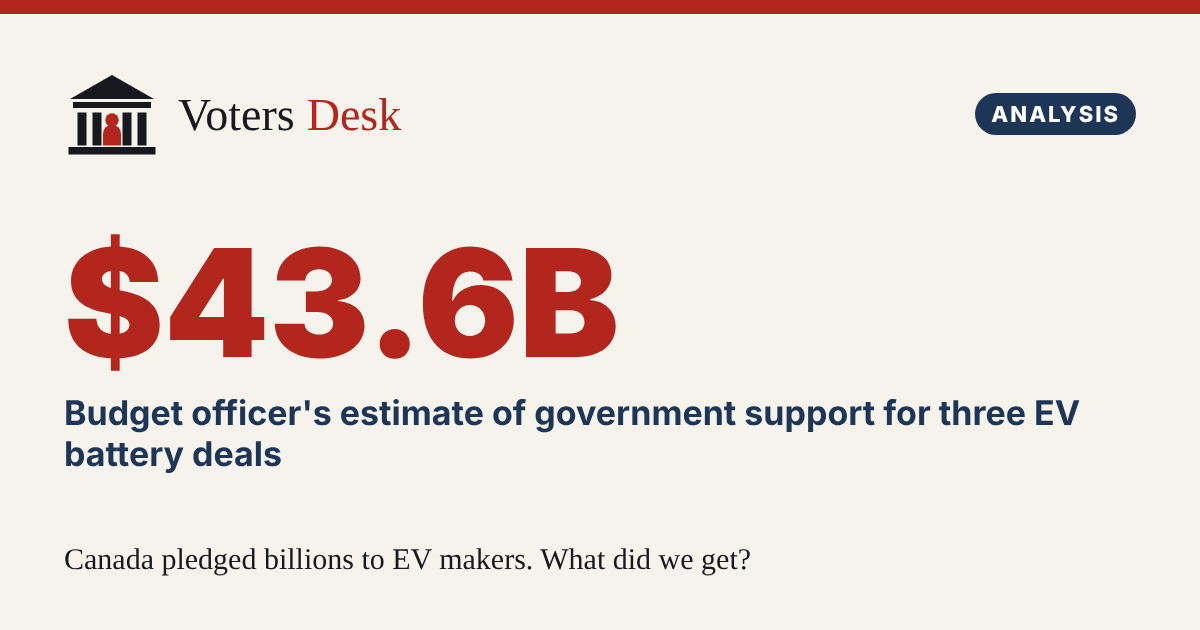
Ottawa and the provinces lined up tens of billions of dollars to land electric vehicle and battery plants. The country's budget officer put the cost of just three of those deals at $43.6 billion. Since then, one company went bankrupt, one shelved its Ontario EV project indefinitely, and one moved a vehicle it had planned to build in Brampton to Illinois and has now agreed to sell the plant. Meanwhile, the small businesses that employ nearly half of private sector workers are watching restaurant and trucking insolvencies climb. Here's what the public was promised, and what it has so far.
$43.6B
PBO estimate of government support for three EV battery deals: Northvolt, Volkswagen and Stellantis-LGES
Source: Parliamentary Budget Officer
$270M
Quebec investment lost when Northvolt's Swedish parent went bankrupt
Source: Government of Quebec
$5B
Public support pledged for Honda's $15-billion Ontario EV project, now suspended indefinitely
Source: BNN Bloomberg
46.6%
Share of private sector employees working for small businesses in 2024
How much did governments promise EV and battery makers?
A lot. In November 2023, the Parliamentary Budget Officer estimated total federal and provincial support for battery manufacturing by Northvolt, Volkswagen and Stellantis-LGES at $43.6 billion from 2022-23 to 2032-33. That was $5.8 billion more than the $37.7 billion governments had announced, because the subsidies themselves reduce the corporate tax governments collect (Parliamentary Budget Officer).
The PBO also estimated when the public would get its production subsidy money back in tax revenue: 11 years for Northvolt, 15 years for Volkswagen and 23 years for Stellantis-LGES (Parliamentary Budget Officer). An earlier PBO report found the production subsidies for Volkswagen and Stellantis-LGES alone, $28.2 billion, would take until 2043 to break even (PBO).
| Northvolt | 11 yrs |
|---|---|
| Volkswagen | 15 yrs |
| Stellantis-LGES | 23 yrs |
PBO estimates from 2023, made before Northvolt's bankruptcy. Figures cover production subsidies only.
Source: Parliamentary Budget Officer, Costing Support for EV Battery Manufacturing (November 2023)
The government's side: Ontario Economic Development Minister Vic Fedeli and Liberal MP Irek Kusmierczyk said the PBO's break-even report missed the wider spinoff benefits of the plants (CBC News). The PBO said it looked only at the fiscal impact of the plants themselves.
What happened to Northvolt's Quebec plant?
It's dead. Northvolt's Swedish parent filed for bankruptcy in March 2025, and in September 2025 Quebec ended the project and confirmed it had lost a $270-million investment in the parent company (Government of Quebec, CBC News). Quebec's pension fund manager, the Caisse de dépôt, lost another $200 million it had put into Northvolt (CBC News). The province did recover nearly $200 million from frozen Northvolt bank accounts against a separate loan (CBC News).
Ottawa had pledged more than $4 billion. Most of it, $3.1 billion, was a production subsidy, paid only as batteries were made (Parliamentary Budget Officer). The federal department told The Logic in March 2025 that it "hasn't paid any money to Northvolt" (The Logic). Quebec's upfront investment was not protected that way.
What happened to Honda's Ontario EV project?
Honda suspended it indefinitely in May 2026. The $15-billion project in Alliston, announced in 2024, was expected to create 1,000 jobs and receive about $5 billion from Ottawa and Ontario. Government officials said none of that money had been paid out (BNN Bloomberg). Honda had already paused it for two years in May 2025, citing slowing EV demand (Global News).
Again, no cash went out the door. The project was announced alongside then-prime minister Justin Trudeau and Premier Doug Ford (Global News). Two years later, there is no EV plant. On November 9, 2026, Honda announced it would retool Alliston for hybrid and gas vehicles instead, part of an $867-million commitment backed by $313 million from Ottawa and $156 million from Ontario (Global News).
What happened at Stellantis in Brampton?
In October 2025, Stellantis announced it would build the Jeep Compass in Illinois instead of at its Brampton plant, as part of a US$13-billion plan to expand in the United States (BNN Bloomberg). About 3,000 Canadian jobs were put in jeopardy. Industry Minister Mélanie Joly wrote to the company that Ottawa would "exercise all options, including legal" (Global News), and Ottawa cut by 50 per cent the number of vehicles Stellantis can import from the U.S. without counter-tariffs (Department of Finance).
Prime Minister Mark Carney said Ottawa expects Stellantis "to fulfill the undertakings they have made to the workers of Brampton" (CP24). Tariffs are part of the backdrop: Stellantis had already paused Brampton work in February 2025 after U.S. tariffs were announced (BNN Bloomberg).
In November 2026, Stellantis agreed to sell the idle Brampton plant to Roshel, an armoured vehicle maker. Carney called the sale "a betrayal of the workers" and said: "We will fully enforce our rights in protection of those workers and in protection of Canadian funds." No lawsuit had been reported as of November 10 (BNN Bloomberg, Global News).
How are small businesses doing?
It depends on the sector. Restaurants, hotels and trucking are seeing more failures, even as overall business insolvencies fell over the past year. Small businesses, with 1 to 99 employees, make up 98.2 per cent of businesses with employees in Canada. They employed 5.8 million people in 2024, or 46.6 per cent of the private sector workforce, compared with 36.4 per cent at large companies (ISED).
| Small businesses (1 to 99) | 46.6% |
|---|---|
| Medium (100 to 499) | 17.0% |
| Large (500 or more) | 36.4% |
Small is 1 to 99 employees, medium 100 to 499, large 500 or more (ISED definitions).
Source: Innovation, Science and Economic Development Canada, SME Research and Statistics
Business insolvencies reached 1,133 in the third quarter of 2026, up 2.3 per cent from a year earlier, according to Office of the Superintendent of Bankruptcy data compiled by CAIRP. Accommodation and food services, which includes restaurants and hotels, had the biggest jump: 182 filings, up 35 from a year earlier (Retail Insider). For balance: over the 12 months to September, business insolvencies were down 5.6 per cent (Office of the Superintendent of Bankruptcy). Consumer insolvencies, which often include owners themselves, have hit their highest quarterly numbers since 2009, though the rate per adult is still below the 2009 peak (Global News).
On October 28, the Bank of Canada raised its policy rate to 2.5 per cent, its first increase in three years (Bank of Canada). Lines of credit tied to prime usually follow.
Who is responsible for what?
- Ottawa (your MP): federal investment tax credits and production subsidies, contracts with automakers, the small business tax rate and federal loan programs.
- The province (your MPP): Ontario's share of the EV deals, provincial grants and the employer health tax.
- Your city: property taxes on business, permits and local business improvement areas.
Find all three on our directory.
What we think
This is our opinion, based on the figures above.
The EV bet wasn't crazy. Every major economy is fighting for these plants, and much of the money was paid only as plants were built or ran, which protected taxpayers when Northvolt collapsed and Honda pulled back. But the public was sold these deals as sure things, with break-even dates the budget officer later found were years longer than governments had said. When they fall apart, nobody who stood at the podium pays any price. And the Stellantis story shows the limit of subsidies: a cheque from Ottawa doesn't outweigh the U.S. market when Washington changes the rules.
Meanwhile, a corner restaurant doesn't get a production subsidy. It gets a higher prime rate. If governments can find tens of billions for multinationals, they can explain, in plain numbers, what they're doing for the restaurant, the trucking company and the repair shop down your street.
What we couldn't confirm
The PBO's $43.6 billion estimate dates from November 2023 and has not been updated in a single public figure since Northvolt's bankruptcy and Honda's suspension. We couldn't find a full official tally of how much EV money has actually been paid out to date. The quarterly insolvency count comes from CAIRP's summary of OSB data; the OSB publishes 12-month figures, which we cite directly.
Quick answers
- How much did Canada spend on EV battery plant subsidies?
- The Parliamentary Budget Officer estimated in 2023 that government support for battery plants by Northvolt, Volkswagen and Stellantis-LGES would total $43.6 billion from 2022-23 to 2032-33, $5.8 billion more than governments announced. Much of it is paid only as batteries are produced.
- Did taxpayers lose money on Northvolt?
- Quebec lost a $270-million investment in Northvolt's Swedish parent, and its pension fund manager lost $200 million. Quebec recovered nearly $200 million against a separate loan. The federal government said in March 2025 it had not paid any money to Northvolt.
- What happened to Honda's EV plant in Ontario?
- Honda indefinitely suspended its $15-billion Alliston EV project in May 2026. It was to receive about $5 billion in federal and Ontario support, none of which had been paid out, according to government officials. In November 2026 Honda announced a separate retooling of Alliston for hybrid and gas vehicles with federal and Ontario support.
Sources
- Parliamentary Budget Officer: Costing support for EV battery manufacturing (2023)
- Government of Quebec: Québec met fin au projet avec Northvolt
- Parliamentary Budget Officer: $28.2 billion in EV battery production subsidies, break even in 20 years
- CBC News: Governments will break even in 20 years on EV plant subsidies
- CBC News: Quebec declares Northvolt partnership dead, loses $270M
- CBC News: Quebec recovers nearly $200M from Northvolt
- The Logic: Federal government has not paid Northvolt
- BNN Bloomberg: Honda indefinitely suspends $15B Ontario EV plant
- Global News: Honda postpones Canadian EV investment
- Global News: Honda to retool Alliston for hybrid and gas vehicles
- Department of Finance: Canada takes action to protect auto industry and workers
- BNN Bloomberg: Carney says Canada will fully enforce its rights after Stellantis plant sale
- Global News: Stellantis sale to Roshel
- Global News: What to know as Stellantis moves auto jobs to the U.S.
- BNN Bloomberg: Stellantis moving Jeep Compass production to Illinois
- CP24: Stellantis moving Jeep Compass production to Illinois
- ISED: SME research and statistics
- Office of the Superintendent of Bankruptcy: Insolvency statistics, September 2026
- Bank of Canada: October 28, 2026 rate announcement
- Retail Insider: Business insolvencies by sector, third quarter 2026
- Global News: Consumer insolvencies, third quarter 2026
Spotted an error? We correct it and note the change at the top of the article. See how we work.
Discussion
Criticize decisions, votes and spending as hard as you like. Threats, slurs, personal attacks and accusations of crimes without a public record are removed. Comments with links or flagged words are reviewed before they appear.
Loading comments…
Get the facts in your inbox
One email with the week's budget and policy analysis, sources linked. Free. Unsubscribe any time.