AnalysisGovernment payAll levels
MPs just got their 14th raise in a row. What politicians earn while you get squeezed
By VotersDesk · · 10 min read
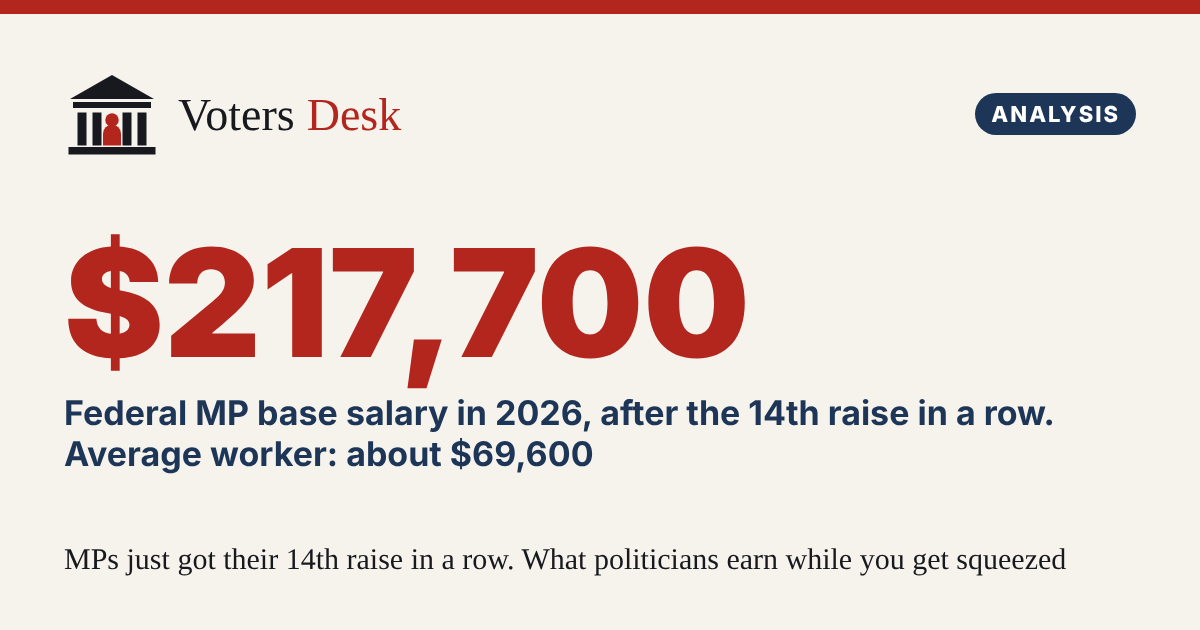
A backbench MP now earns $217,700 a year, after the 14th raise in a row. Ontario MPPs got a 35 per cent raise and a new pension last year, then another 4.2 per cent this April. The Bank of Canada governor's salary range tops out at $544,800, and the Bank has refused to release what its governors are actually paid, a refusal now being challenged in Federal Court. Meanwhile the average Canadian employee earns about $69,600, unemployment is 6.7 per cent, and wages are rising slower than prices. Here's what the people making the big decisions earn, how their pay is set, and how it compares with yours.
$217,700
Base salary of a federal MP since April 1, 2026, the 14th raise in a row
Source: Canadian Taxpayers Federation, using government data
$435,400
Prime Minister's total pay: MP salary plus an equal amount for running the government
Source: PublicSalaries.com, from the Parliament of Canada Act
$544,800
Top of the Bank of Canada governor's salary range, unchanged since 2017 on the Bank's own page
Source: Bank of Canada
$69,600
Average Canadian employee's annual earnings, from weekly earnings of $1,338.24 in February 2026 (our arithmetic)
Source: Statistics Canada
How much do MPs and cabinet ministers earn?
A lot more than most of the people they represent. Since April 1, 2026, every MP gets a base salary of $217,700. A cabinet minister earns $321,300 and the Prime Minister $435,400 (PublicSalaries.com). The latest increase ranged from $7,900 to $15,800 depending on the role, and the Canadian Taxpayers Federation counts it as the 14th raise in a row. It cites Leger polling that found 80 per cent of Canadians opposed it (Canadian Taxpayers Federation).
| Bank of Canada governor (top of range) | $544.8K |
|---|---|
| Prime Minister | $435.4K |
| Federal cabinet minister | $321.3K |
| Ontario premier | $282.1K |
| Federal MP | $217.7K |
| Ontario MPP | $164.0K |
| Average Canadian employee | $69.6K |
Average employee figure is our arithmetic: $1,338.24 a week x 52 (Statistics Canada, February 2026). Ontario premier figure is from 2025; it is now indexed to federal pay.
Source: PublicSalaries.com, Bank of Canada, Global News, Narcity, Statistics Canada
By our arithmetic, a backbench MP earns about three times what the average employee does, and the Prime Minister about six times.
How do politicians decide their own raises?
Mostly, they don't have to vote on them. Federal MP pay goes up automatically every April 1, tied to an index of base wage increases in major private-sector union settlements (Global News). That formula is in the Parliament of Canada Act, so the raise happens unless MPs change the law to stop it.
Here's the catch. Union settlements are not the same as what most workers get. Over the year to October, average hourly wages rose 2.2 per cent while prices rose 3.1 per cent (our October rate hike analysis). This year's backbench MP raise was $7,900, taking pay from $209,800 to $217,700, about 3.8 per cent by our arithmetic (Canadian Taxpayers Federation). Most Canadians don't get a raise guaranteed by law every year regardless of performance.
What did Ontario MPPs give themselves?
A 35 per cent raise and a pension. In May 2025, a bill passed all three readings within minutes and raised base MPP pay from $116,550 to 75 per cent of a federal MP's salary (Global News). The Premier's pay went from about $209,000 to about $282,000 and cabinet ministers' from about $166,000 to about $224,000 (HCAMag). Every party supported it.
On April 1, 2026, the same day Ontario's minimum wage rose about 2 per cent, MPPs got another 4.2 per cent, taking a backbencher from $157,350 to $163,959 (Global News).
To be fair, MPP pay had been frozen since 2009, and Ontario's former integrity commissioner recommended lifting the freeze because it may have been driving turnover (The Trillium). Even after the raise, MPPs earn less than Toronto city councillors (blogTO). But Premier Doug Ford also said he would not shrink his cabinet or parliamentary assistant roster after the raise (Global News).
Is politicians' travel paid for by taxpayers?
Yes, for work travel, and the bills are public. MPs spent a record $187.8 million in 2024, including $32 million on travel, $114.1 million on staff salaries and $1.9 million on hospitality (CP24). That works out to an average of $547,000 per MP, on top of salary (CP24). The top spender billed $775,000, including $328,000 on travel (CP24).
Some of that is the cost of the job. An MP from Nunavut or northern Quebec has to fly, and staff salaries pay for constituency offices that help people with passports and benefits. But House travel rules also cover an MP's designated travellers, not only the MP, and the spending gaps between MPs are large. You can look up your own MP's travel claims on the House of Commons proactive disclosure site (House of Commons). At Queen's Park, MPPs' travel and Toronto accommodation claims are published too (Legislative Assembly of Ontario).
What about pensions?
MPs have a defined benefit pension under the Members of Parliament Retiring Allowances Act. For service from 2016 on, an MP with six years of service can get an unreduced pension at 65 (Treasury Board of Canada Secretariat). Ontario MPPs got a pension plan back in 2025 for the first time in decades (blogTO).
Compare that with the private sector, where most workers have no workplace pension at all and rely on their own savings and the Canada Pension Plan. That's a point people are entitled to raise.
How much does the Bank of Canada governor make?
We don't know exactly, and that's the problem. The Bank publishes a salary range for the governor of $463,100 to $544,800, and $324,300 to $381,500 for the senior deputy governor. Its page says the range has applied from 2017 to the present (Bank of Canada). It doesn't say where in the range the governor sits, or what bonuses or performance pay, if any, are paid.
In March 2026, the Canadian Taxpayers Federation went to court to force the Bank to release records of what governors and senior deputy governors were paid from 2012 to 2023, including salaries, bonuses and performance pay (Canadian Taxpayers Federation). Provinces publish public-sector salaries over a set threshold every year. The central bank that sets everyone's borrowing costs does not publish its top officials' actual pay.
Governor Tiff Macklem's term ends June 2, 2027, and he will not seek a second one (Bank of Canada). Before becoming governor, he served as a director of the Bank of Nova Scotia (Bank of Canada). Moving between top government, central bank and big-bank roles is common in Canada. It isn't evidence of wrongdoing, but it is why many people feel these decisions are made by a small circle.
Do they make changes without asking citizens?
Sometimes, yes. Ontario's MPP raise went from introduction to law within minutes (Global News). The federal MP raise happens automatically each year with no vote. The Bank of Canada's new five-year framework was agreed between the Bank and the finance minister, not voted on by Parliament, although the Bank did run public consultations first (our Bank of Canada analysis).
We looked for evidence that these decisions were made in consultation with banks or wealthy donors. We didn't find any for the pay raises. That doesn't mean influence doesn't exist. It means it isn't in the public record we could check, and we won't claim it.
Are government workers getting bigger raises than private workers?
It's mixed, and the data cuts both ways. On average, public sector employees earn more per hour: $40.83 in 2024, more than private sector employees. But since 2006, average hourly wages grew faster in the private sector, up 22.0 per cent, against 7.6 per cent in the public sector (Statistics Canada).
Comparing like with like, the Fraser Institute found government workers earned 4.8 per cent more than similar private sector workers in 2024, and 7.9 per cent more in Ontario (The Hub, HR Reporter). The left-leaning Canadian Centre for Policy Alternatives points out the reverse at the top: senior executives are paid 35 per cent more in the private sector (CCPA).
Job security is where the gap is starkest. In October, private sector employment fell by 53,000 while the public sector added 50,000 (Canada Pay Insights, using Statistics Canada data). That said, governments have also been cutting: the public sector lost about 8,700 jobs in the first four months of 2026 (The Hub).
Do bank executives get raises and bonuses while borrowers pay more?
Yes. Most big bank CEOs got raises for 2025. RBC paid Dave McKay $22 million in total direct compensation, about 30 per cent above target, in a year RBC earned $20.4 billion (The Logic). BMO's Darryl White got about $17 million, up 55 per cent (The Logic). Scotiabank's Scott Thomson earned about $12.58 million, up 29 per cent and roughly 90 times the bank's average employee pay (The Logic). TD's Raymond Chun's $14.6 million was about 82 times the average full-time employee's pay (The Logic).
Those are private companies paying from their own profits, not tax dollars. But as we showed in our Bank of Canada analysis, each quarter-point rate hike moves about $1.28 billion a year from borrowers with variable mortgages and home equity lines to lenders, by our sum of Equifax figures.
What we think
This is our opinion, based on the figures above.
Paying elected officials fairly matters. If the job pays too little, only the already rich can afford to do it. But fair pay should follow the people it serves. A federal MP's raise is tied to union settlements, not to what the average worker actually got. MPPs voted themselves a 35 per cent raise in minutes, with every party on board. And the Bank of Canada refused to release its governors' real pay, leaving taxpayers to go to court for it, while asking Canadians to accept higher borrowing costs.
Here's a simple test any politician can pass: tie your raise to the median worker's wage growth, freeze it in any year unemployment rises, and publish every dollar of pay and expenses in one place. If people who tell us to tighten our belts won't accept rules like that, voters should ask why.
What we couldn't confirm
We could not confirm the Bank of Canada governor's actual salary or any bonus; the Bank publishes only a range. The average-employee figure is our arithmetic from Statistics Canada's average weekly earnings. The Ontario premier's $282,129 is the 2025 figure reported when the law passed; his pay is now indexed to federal pay, and we couldn't find an official 2026 figure. We found no record showing politicians consulted banks or donors on their own pay.
Quick answers
- How much does a Canadian MP earn in 2026?
- A federal MP earns a base salary of $217,700 since April 1, 2026. A cabinet minister earns $321,300 and the Prime Minister $435,400.
- How are MP raises decided?
- MP pay rises automatically every April 1 under the Parliament of Canada Act, tied to an index of base wage increases in major private-sector union settlements. No annual vote is needed.
- How much do Ontario MPPs make?
- Ontario raised MPP base pay 35% in 2025, from $116,550 to 75% of a federal MP's salary, and created a pension plan. A 4.2% increase on April 1, 2026 took a backbench MPP to $163,959.
- How much is the Bank of Canada governor paid?
- The Bank publishes a range of $463,100 to $544,800 for the governor but not the actual salary or any bonus. The Canadian Taxpayers Federation went to court in 2026 to get those records released.
- How much do MPs spend on travel?
- MPs spent a record $187.8 million in 2024, including $32 million on travel and $114.1 million on staff salaries, an average of $547,000 per MP on top of salary.
Sources
- Canadian Taxpayers Federation: MP pay increased between $7,900 and $15,800
- PublicSalaries.com: Members of Parliament salaries set by law
- Global News: How MP pay is indexed each April
- Global News: Ford says he won't reduce cabinet after MPP pay bump
- Global News: MPPs in Ontario receive 4.2% raise
- HCAMag: Ontario MPPs given pay raise, pension
- The Trillium: Ontario MPPs to get salary bump and new pension plan
- blogTO: Ontario politicians to get $41,000 raises
- Narcity: Ontario politicians salary increases
- CTV News: Canada's MPs spent $187.8M in 2024
- CP24: MPs spent record-breaking $187.8 million in 2024
- House of Commons: Understanding expenditure reports for Members
- Legislative Assembly of Ontario: Members' expenditures 2025-26
- Treasury Board of Canada Secretariat: MP Pension Plan FAQ
- Bank of Canada: Board of Directors and compensation
- Canadian Taxpayers Federation: Court fight to reveal Bank of Canada executive pay
- Bank of Canada: Governor Macklem will not seek a second term
- Bank of Canada: Tiff Macklem profile
- Statistics Canada: Payroll employment, earnings and hours, February 2026
- Statistics Canada: Quality of Employment in Canada, average earnings 2024
- The Hub: Government workers make more and get better pensions (Fraser Institute study)
- HR Reporter: Public sector pay in Ontario and B.C. versus private sector
- CCPA: Fairer pay in the public sector, 2025
- Canada Pay Insights: Wages up 2.2%, inflation 3.1% (October 2026)
- The Hub: 112,000 private sector jobs lost in 2026
- The Logic: RBC, National Bank CEOs see pay increases
- The Logic: BMO CEO gets biggest pay bump among peers
- The Logic: TD, Scotiabank CEOs see pay increases
- The Logic: Bank CEO pay ratios
Spotted an error? We correct it and note the change at the top of the article. See how we work.
Discussion
Criticize decisions, votes and spending as hard as you like. Threats, slurs, personal attacks and accusations of crimes without a public record are removed. Comments with links or flagged words are reviewed before they appear.
Loading comments…
Get the facts in your inbox
One email with the week's budget and policy analysis, sources linked. Free. Unsubscribe any time.