AnalysisEconomyFederal
Bank of Canada hiked rates as Canada lost jobs. Who pays?
By VotersDesk · · 7 min read
Canada lost 42,000 jobs in August and 68,000 in September. On October 28, the Bank of Canada decided this was the moment to make borrowing more expensive. A week later, October's numbers came in: employment was little changed, down 4,700, unemployment rose to 6.7 per cent and youth unemployment hit 13.7 per cent. If that sounds backwards, it should. Here's what the Bank actually did, why it says it did it, and who ends up paying.
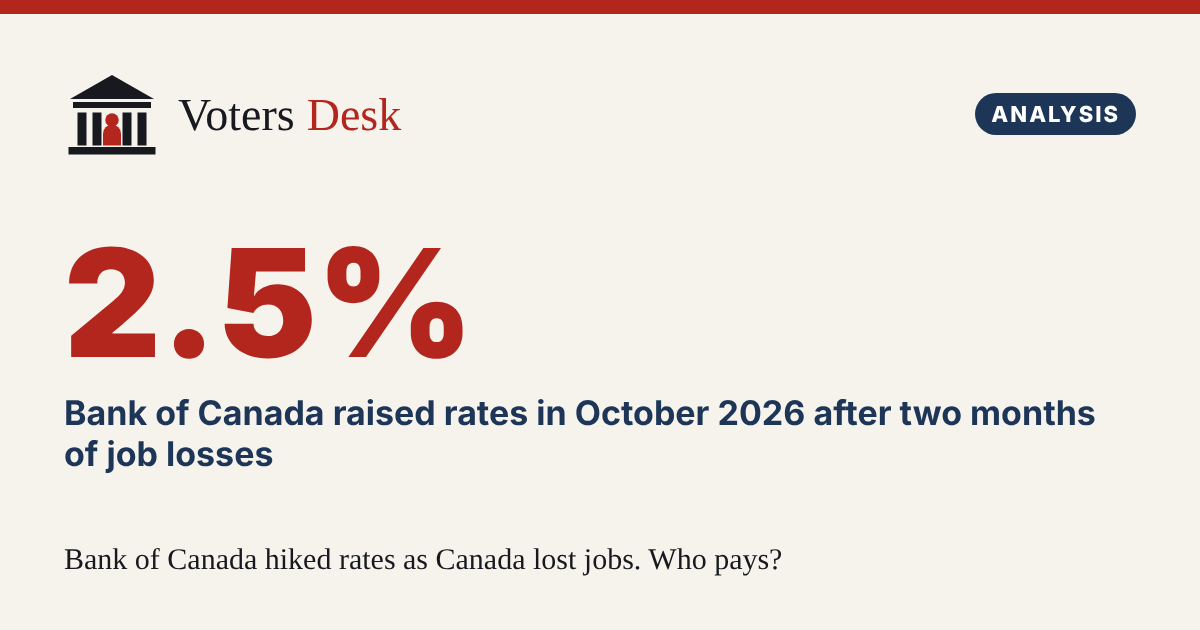
2.5%
Bank of Canada policy rate after the October 28 hike
Source: Bank of Canada
6.7%
Canada unemployment rate, October 2026. Ontario is at 7.3%
Source: Statistics Canada
13.7%
Unemployment rate for Canadians aged 15 to 24, up 0.7 points in one month
Source: Statistics Canada
2.2%
Year-over-year growth in average hourly wages, while prices rose 3.1%
Source: Statistics Canada
Why did the Bank of Canada raise interest rates in October 2026?
Because of high energy prices. The Bank raised its policy rate by a quarter point to 2.5 per cent, saying it wanted to "reduce the risk that continuing high energy prices spread broadly to the prices of other goods and services" (Bank of Canada). It was the first increase since July 2023 (TD Economics).
That reason matters. Gasoline prices were up 30.9 per cent from a year earlier in October, partly because prices were low a year ago (Statistics Canada). Take energy out, and inflation was 2.0 per cent, right on the Bank's target. Grocery prices were up 2.0 per cent. Shelter was up 1.4 per cent.
So the Bank is not raising rates because Canadians are out spending too much. It's raising rates because oil got expensive, mostly for reasons outside Canada. The Canadian Press reported the hike was a response to higher global energy prices from the war in the Middle East (Advisor.ca). An interest rate hike in Ottawa does nothing to the price of a barrel of oil. What it does is make every variable mortgage, line of credit and car loan in the country cost more.
How bad is unemployment in Canada right now?
Worse than it's been in a while. The national unemployment rate rose to 6.7 per cent in October. In Ontario it rose to 7.3 per cent. About 1.5 million Canadians are looking for work, and nearly one in four of them, 23.7 per cent, have been looking for 27 weeks or more, up from 21.5 per cent a year earlier (Statistics Canada).
| Aug 2026 | -42.0K |
|---|---|
| Sept 2026 | -68.0K |
| Oct 2026 | -4.7K |
Negative values are jobs lost. About 115,000 jobs lost over three months.
Source: Statistics Canada, Labour Force Survey, October 2026
Private sector employees fell by 53,000 in October alone. Retail and wholesale lost 29,000 jobs. Young people are hit hardest: the youth rate jumped to 13.7 per cent, and students looking for work faced 13.5 per cent (Statistics Canada, Global News).
The Bank of Canada knows this. Its own statement says the unemployment rate "has been around 6½% for several months" and that there is "some excess supply in the economy" (Bank of Canada). In plain words: the economy has slack, people want jobs that aren't there, and the Bank raised rates anyway.
Are wages keeping up with prices?
No. Average hourly wages rose 2.2 per cent over the year to October, to $37.89 (Statistics Canada). Prices rose 3.1 per cent over the same period (Statistics Canada). That gap means the average worker's paycheque buys less than it did a year ago.
| Average hourly wages | 2.2% |
|---|---|
| Consumer prices | 3.1% |
Source: Statistics Canada, Labour Force Survey and Consumer Price Index, October 2026
For what that gap means at the grocery store, see our cost-of-living breakdown.
So the squeeze comes from three directions at once. Pay rises slower than prices. Jobs are harder to find. And now the cost of carrying debt is going up.
What does the rate hike mean for my mortgage?
If you have a variable-rate mortgage or a line of credit, you pay more now. The big banks' prime rate moves with the Bank of Canada's rate, and after this hike the six big banks raised prime from 4.45 per cent to 4.70 per cent, effective October 29 (National Bank, MPA). On a $500,000 variable mortgage, a quarter point is roughly $1,250 a year in extra interest. That's our own simple calculation, before any payment adjustment your lender makes.
Canadian households already spend 14.52 per cent of their disposable income just on debt payments, principal and interest, according to Statistics Canada's latest numbers for the second quarter of 2026. That's down from a peak of 15.16 per cent in early 2023, but still a big bite. Households owe about $1.76 for every dollar of disposable income (Statistics Canada, MPA). Those numbers were measured before this hike.
And renewals are still coming. The Bank of Canada's own 2026 Financial Stability Report estimated that at current home prices about 4 per cent of borrowers renewing in 2027 would not be able to refinance, rising to about 9 per cent in the Toronto area (Bank of Canada). Those are borrowers with little equity, heavy debt loads and no room left to stretch their amortization. They could still renew, but they'd have few ways to soften a bigger payment (TD Economics). That's exactly the group a rate hike hurts most.
Will the Bank of Canada raise rates again in December 2026?
It might. The next decision is December 9, 2026 (Bank of Canada). The Bank said there "could be a need to increase the policy rate further" (Bank of Canada), and TD Economics reports it will take decisions one meeting at a time (TD Economics).
Market players expect more. The Bank's own quarterly survey of 25 market participants, taken in late September before the October hike, expected a quarter-point increase in December (Dow Jones via Morningstar). After the hike, markets put the odds of another quarter-point increase on December 9 at 43 per cent, according to LSEG data reported by The Canadian Press (Advisor.ca).
Not everyone agrees. BMO's chief economist Douglas Porter said falling oil prices and three straight months of job losses could persuade the Bank to pause in December (Dow Jones via Morningstar). The November inflation number comes out December 14, after the decision (Statistics Canada), so the Bank will decide with October's inflation data in hand.
Who is responsible for what?
The Bank of Canada is independent. No minister sets the interest rate, and that independence exists for good reasons: you don't want politicians cutting rates before every election. But independence is not the same as being beyond question. The Bank answers to Parliament through the finance committee, and its governor testifies there. You can find your MP by postal code.
In Ontario, the pump price includes the provincial gasoline tax of 9 cents a litre and 13 per cent HST (Government of Ontario, Natural Resources Canada). Ottawa suspended its 10-cent federal excise tax on April 20, 2026, and has extended the suspension to January 31, 2027, with half the tax returning until full rates come back on April 1, 2027 (Department of Finance). The federal consumer carbon price ended on April 1, 2025. Fuel taxes are choices made by governments you elect. If energy prices are the problem, governments hold tools that work directly on the pump price. An interest rate hike is a blunt tool that works on everyone with debt.
What we think
This is our opinion, based on the figures above.
The Bank says it's acting to protect Canadians' confidence in stable prices. Fair enough. Inflation that runs away hurts working people worst, and nobody wants a repeat of 2022. But look at who carries this decision. Not the people with paid-off homes and cash in the bank, who can earn a bit more on their savings when rates rise. The weight lands on young families with variable mortgages, on renters whose landlords may pass on higher costs, on small businesses running on lines of credit, and on the 1.5 million people looking for work in an economy that just got a little harder to hire in.
Raising rates after two straight months of heavy job losses, to fight an oil price set on world markets, is a choice. People are entitled to ask whether it's the right one, and to ask their MP what Ottawa plans to do for jobs and household debt when the fuel tax break runs out in January.
What we couldn't confirm
We could not find a national rent figure in the October inflation release, so we've left rent out. The release does say rent rose more slowly, and gives a figure for Ontario only (1.1 per cent). The $1,250 figure for a $500,000 mortgage is our own simple interest estimate; your actual cost depends on your lender, your contract and whether your payment is fixed or variable.
Quick answers
- Why did the Bank of Canada raise interest rates in October 2026?
- The Bank raised its policy rate by a quarter point to 2.5 per cent on October 28, 2026, to reduce the risk that high energy prices spread to the prices of other goods and services. It was the first increase since July 2023.
- Will the Bank of Canada raise rates again in December 2026?
- Possibly. The next decision is December 9, 2026. The Bank said there could be a need to raise rates further. Market participants surveyed by the Bank expected a quarter-point hike in December, while some economists, including BMO's, think job losses could lead to a pause.
- What is the unemployment rate in Canada right now?
- Statistics Canada reported 6.7 per cent for October 2026, with youth unemployment at 13.7 per cent and Ontario at 7.3 per cent. Canada lost about 115,000 jobs from August to October.
Sources
- Bank of Canada: October 28, 2026 rate announcement
- Statistics Canada: Labour Force Survey, October 2026
- Statistics Canada: Consumer Price Index, October 2026
- Statistics Canada: National balance sheet, second quarter 2026
- Bank of Canada: Financial Stability Report 2026, households
- TD Economics: Bank of Canada rate announcement, October 28, 2026
- TD Economics: Read the fine print on the Bank's mortgage warning
- Dow Jones via Morningstar: Market participants expect one more Bank of Canada hike
- Advisor.ca (The Canadian Press): Bank of Canada delivers first hike in three years
- Global News: Unemployment ticked up to 6.7% in October
- National Bank: Prime rate increase, October 2026
- MPA: Prime rate hits 4.70% as big banks act on BoC hike
- Department of Finance: Federal fuel excise tax relief extended
- Government of Ontario: Gasoline tax
- Natural Resources Canada: Fuel consumption levies in Canada
- MPA: Canadians' debt burden eases as incomes outpace borrowing
Spotted an error? We correct it and note the change at the top of the article. See how we work.
Discussion
Criticize decisions, votes and spending as hard as you like. Threats, slurs, personal attacks and accusations of crimes without a public record are removed. Comments with links or flagged words are reviewed before they appear.
Loading comments…
Get the facts in your inbox
One email with the week's budget and policy analysis, sources linked. Free. Unsubscribe any time.